
When tourism is discussed, most people think first of hotel occupancy rates, duty-free sales, or visitor arrivals. Governments, too, tend to measure success by the number of international visitors and the revenue they generate. Such an approach, however, captures only a fraction of tourism’s economic significance.
In the modern economy, tourism is no longer merely a consumption industry. It is increasingly a platform that generates spillover effects capable of enhancing productivity and competitiveness across a wide range of sectors.
Economists have long recognised the multiplier effect. When an international visitor stays in a hotel, spending ripples through restaurants, transport providers, cultural attractions, agricultural suppliers, laundry services and financial institutions. An initial injection of tourist expenditure circulates repeatedly through the economy, raising income and employment.
Yet the more important concept today is not the multiplier effect but the spillover effect.
Whereas the multiplier describes the repeated circulation of spending, spillovers explain how tourism creates entirely new economic value by connecting industries that would otherwise remain separate. Tourist expenditure does not end at the hotel reception desk. It stimulates demand for cultural content, accelerates innovation in digital services, strengthens regional brands, attracts investment and expands international business opportunities. Tourism therefore becomes more than a source of consumption; it becomes a catalyst for higher economic productivity.
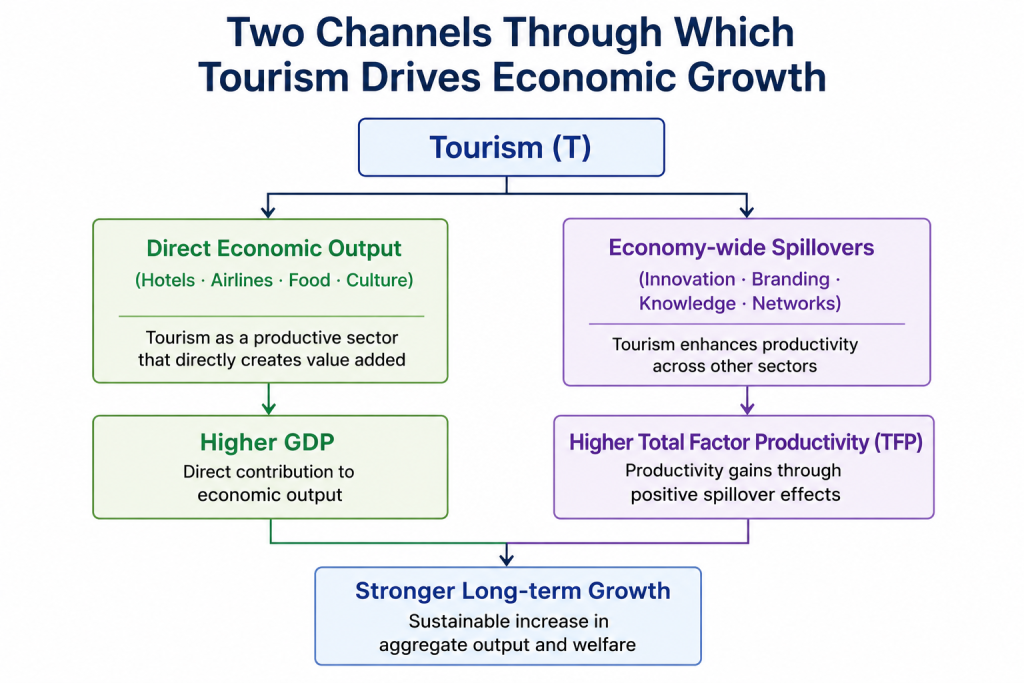
Modern growth economics provides a useful framework for understanding this transformation. Rather than viewing tourism simply as a source of additional demand, modern growth economics recognises tourism as both a productive sector in its own right and a driver of economy-wide productivity. Aggregate output may be represented as
where K denotes capital, L labour, and T tourism services as a productive sector that contributes directly to output. The term A(T) captures the broader productivity gains generated by tourism through knowledge diffusion, innovation, network formation, destination branding and other spillover effects. The condition \frac{\partial A(T)}{\partial T}>0 implies that tourism not only generates value directly through its own production but also raises the productivity of other sectors through positive spillover effects. In this interpretation, tourism contributes not merely by expanding economic activity within the tourism sector itself, but also by fostering knowledge diffusion, strengthening networks, encouraging innovation and accumulating intangible assets such as reputation and brand value.
Conceptually, tourism drives economic growth through two distinct channels, as illustrated below.
South Korea provides a compelling illustration of this mechanism.
The Korean Wave has attracted international visitors through television dramas and K-pop. Those visitors subsequently purchase Korean cosmetics, food products, fashion and medical services. Many return home not only as consumers of Korean brands but also as potential business partners for Korean firms. Tourism strengthens the cultural industries, while the expansion of those industries generates additional tourism demand. The result is a self-reinforcing cycle in which each sector amplifies the other.
Such dynamics are by no means unique to Korea.
As visitor numbers rise, benefits extend well beyond hotels and restaurants. Local products gain stronger brand recognition, entrepreneurship becomes more vibrant, transport and digital infrastructure improve, and international conventions facilitate technology transfer and business collaboration. A country’s image, shaped partly through tourism, can influence foreign investment and export competitiveness. The economic impact of tourism therefore extends far beyond the boundaries of the tourism industry itself.
The problem is that public policy continues to focus overwhelmingly on tourism’s most visible outcomes.
Governments frequently evaluate tourism policy by counting visitor arrivals or measuring tourism receipts. Yet the true economic value of tourism lies in the extent to which its benefits spread throughout the wider economy and ultimately raise productivity. Tourism policy should therefore be assessed not only by visitor numbers but also by its contribution to exports, investment, innovation, entrepreneurship and long-term productivity growth.
This perspective also reshapes the economic rationale for government intervention. The knowledge, networks and productivity gains generated by tourism create spillover benefits that individual firms cannot fully appropriate. Because these wider gains are not completely reflected in market prices, private investment is likely to fall short of the socially desirable level.
As long as tourism is viewed merely as a service industry, policy will remain preoccupied with attracting more visitors. Once tourism is recognised as a platform that connects industries and raises total factor productivity, however, the objective changes fundamentally. Tourism ceases to be simply an industry that brings in travellers; it becomes an integral part of the economic infrastructure that underpins national productivity and long-term competitiveness.
Only then can tourism be understood not merely as an engine of consumption, but as a platform for innovation, productivity and sustained economic growth.