
This article analyzes travel consumption patterns using microdata from the third quarter (July~September 2025) of the Japan national tourism survey released by the Japan Tourism Agency under the Ministry of Land, Infrastructure, Transport and Tourism. The principal component analysis (PCA) summarizes the joint variation in three expenditure-based travel purposes, leisure travel, visiting friends and relatives (VFR), and business trips, across demographic, regional, and occupational categories. The PCA biplot embedded in this section visually represents both the loading structure of travel purposes and the relative positioning of population groups in the reduced two-dimensional space.
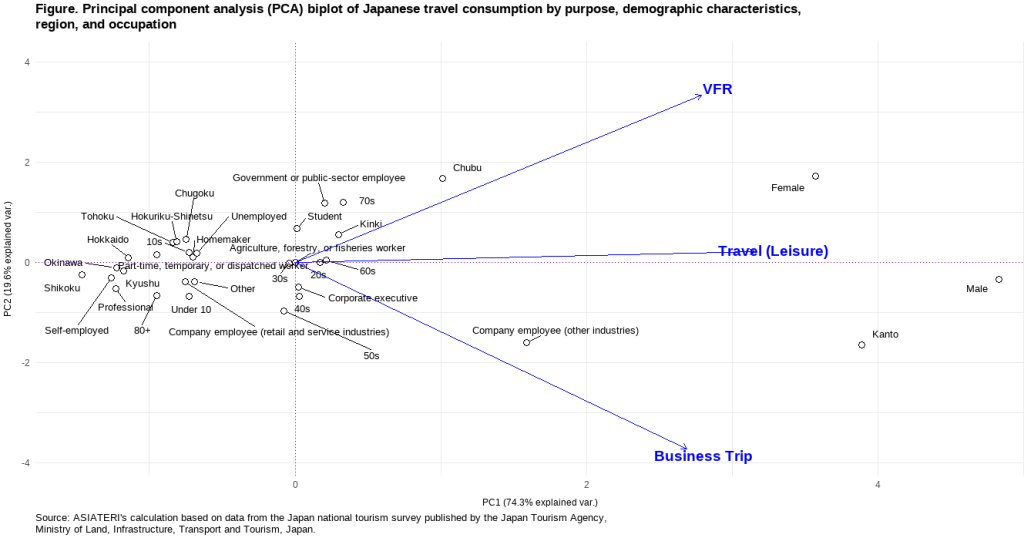
The first principal component (PC1), explaining 74.3% of total variance, captures a generalized travel consumption intensity shared across all three travel purposes. Positive loadings for leisure, VFR, and business expenditures indicate that higher PC1 scores correspond to groups with broadly elevated travel spending. In the biplot, males and residents of the Kanto region, comprising Tokyo, Kanagawa, Chiba, Saitama, Ibaraki, Tochigi, and Gunma, lie far along the positive PC1 axis, signaling their dominant contribution to aggregate travel expenditure. By contrast, peripheral regions such as Shikoku, Kyushu, and Okinawa cluster on the negative side, reflecting comparatively lower consumption levels. This spatial gradient suggests a strong metropolitan concentration of outbound travel demand in Japan’s largest economic corridor.
The second principal component (PC2), accounting for 19.6% of variance, differentiates travel purpose orientation rather than overall spending magnitude. VFR loads positively while business travel loads negatively, producing a vertical separation in the biplot. Older cohorts, particularly individuals in their 70s, as well as females and residents of Chubu appear in the positive PC2 region, indicating a stronger association with socially motivated or family-related travel. Conversely, employees in non-retail industries and Kanto residents occupy the negative PC2 space aligned with business travel intensity. This contrast reveals a structural segmentation between relationship-driven mobility and work-related travel within Japan’s outbound market.
Age and occupational groupings further reinforce this dual structure. Middle-aged cohorts (40s–50s) align more closely with the business-oriented quadrant, whereas younger and student-related categories cluster near the origin, implying moderate and less specialized travel behavior. Public-sector workers and students show positive PC2 tendencies consistent with VFR-type mobility, while self-employed and professional groups remain positioned in lower-spending regions of the PC1 dimension. The proximity of many occupational categories to the center of the biplot indicates that gender and metropolitan residence exert stronger explanatory power than job classification in shaping aggregate travel expenditure patterns.
Overall, the PCA reveals a two-tier structure of Japanese outbound travel consumption:
(1) a dominant metropolitan spending gradient captured by PC1, and
(2) a secondary segmentation between social/VFR and business travel motivations captured by PC2.
The embedded PCA biplot provides an integrated visualization of these relationships, demonstrating how demographic and regional heterogeneity jointly structure Japan’s travel economy in the post-pandemic recovery phase.