
The principal component analysis (PCA) based on quarterly Japanese outbound travel micro-aggregation for July~September 2025 reveals a strongly structured two-dimensional behavioral space that captures the dominant heterogeneity in travel purpose, companionship, duration, and booking modality. The first principal component (PC1) explains 79.3% of the total variance, while the second component (PC2) accounts for an additional 14.1%, jointly summarizing more than nine-tenths of observed variation and therefore providing a robust low-dimensional representation of outbound travel behavior. As visualized in the accompanying PCA biplot, PC1 primarily differentiates independent, digitally mediated, and regionally proximate travel from agency-mediated, packaged, and longer-haul travel configurations. Negative PC1 scores, positioned on the left side of the biplot, are closely associated with independent travel, online booking, Asia-bound destinations, and visiting-friends-and-relatives (VFR) or leisure-oriented purposes, indicating flexible, lower-commitment mobility patterns. In contrast, positive PC1 scores cluster agency counter booking, package or group tours, North American and European destinations, and multi-night stays, reflecting higher transaction intensity, longer planning horizons, and greater expenditure commitment typical of organized long-distance tourism.
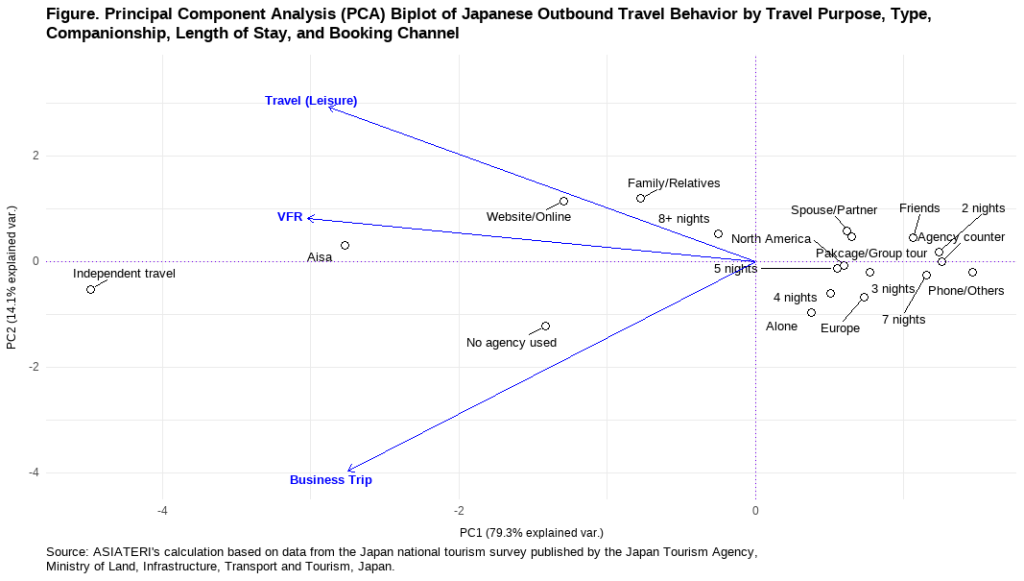
The second principal component (PC2) introduces an orthogonal contrast that separates family- or partner-accompanied, longer-stay leisure structures from solo or minimally mediated travel associated with shorter or functionally motivated trips, including business travel. In the biplot, family/relatives companionship and extended stays (eight nights or more) load positively on PC2 together with leisure travel, whereas business travel and the absence of agency use occupy the negative PC2 direction, indicating compressed itineraries and utilitarian mobility. This vertical differentiation refines the horizontal PC1 gradient by distinguishing travel intensity and social embeddedness rather than organizational modality alone.
Importantly, the spatial configuration of destinations and booking channels in the PCA biplot underscores a coherent tourism-economic segmentation: Asia aligns with digitally enabled, repeatable, and relatively lower-cost circulation; Europe and North America align with agency intermediation, packaged arrangements, and multi-night stays; and independent versus organized travel forms constitute the dominant structural divide in outbound demand formation.
Collectively, the PCA evidence indicates that Japanese outbound tourism during the quarter was governed less by simple destination choice and more by an integrated behavioral bundle linking purpose, social context, booking technology, and trip duration, thereby offering a compact structural interpretation suitable for tourism-economics modeling and policy inference.