
The principal component analysis based on Japanese outbound travel data for the third quarter of 2025 (July~September) reveals a clear two-dimensional structure explaining 81.6% of the total variance (PC1 = 58.0%, PC2 = 23.6%), indicating that heterogeneous travel behavior across demographic groups, residential regions, and destination markets during this period can be summarized by a fundamental economic trade-off between travel frequency and per-trip value. The accompanying PCA biplot visually reinforces this structure by simultaneously displaying observation clusters and variable loading vectors, thereby illustrating how frequency, expenditure, and length of stay jointly organize the outbound tourism system within a reduced-dimensional economic space. The first principal component loads positively on expenditure per trip and length of stay while loading negatively on trip frequency, representing a continuum from frequent, low-cost, short-duration travel to infrequent, high-value, long-stay travel. The second component further differentiates life-cycle travel behavior by contrasting youth-driven short-cycle mobility with mature long-duration consumption patterns. Together, these dimensions demonstrate that Japanese outbound tourism in the third quarter of 2025 is primarily structured by the tension between mobility intensity and economic value per journey.
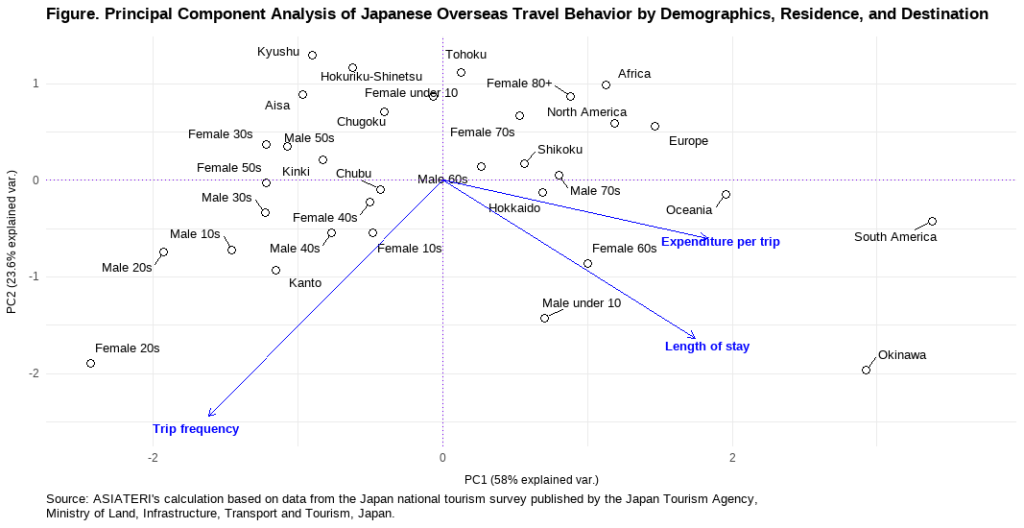
Demographic positioning within the PCA space strongly supports a life-cycle interpretation of tourism demand, a pattern that is also clearly observable in the spatial distribution of points in the biplot. Teenagers and individuals in their twenties, most prominently females in their twenties, cluster in the quadrant associated with high frequency, short stays, and relatively low expenditure per trip, reflecting price-sensitive and mobility-oriented travel consistent with budget and short-haul tourism behavior during the summer travel season. Travelers in their thirties through fifties occupy transitional positions near the origin or moderately negative PC1 values, indicating a gradual shift from quantity-oriented travel toward quality-oriented consumption as income stability and household responsibilities evolve. In contrast, individuals aged sixty and above move decisively into the positive PC1 region, where the biplot shows strong alignment with the expenditure and length-of-stay vectors, combining lower travel frequency with substantially longer stays and higher spending per trip. This confirms the emergence of senior-driven premiumization in outbound tourism, an outcome consistent with structural aging in advanced economies and particularly salient in mid-year peak travel conditions.
Regional heterogeneity within Japan further reinforces this value–frequency dichotomy and is visually evident in the dispersion of regional observations across the biplot plane. The Kanto metropolitan region, comprising Tokyo, Kanagawa, Chiba, Saitama, Ibaraki, Tochigi, and Gunma, corresponds to a pattern of frequent yet lower-value travel, a tendency attributable to dense transportation networks, time constraints, and close proximity to major outbound gateways that enable repeated short-haul trips during the quarter.
Peripheral regions, including Hokkaido, Shikoku, and especially Okinawa, shift toward the high-value, long-stay end of the spectrum, with Okinawa appearing as a pronounced outlier positioned strongly in the direction of the expenditure and duration vectors. This spatial configuration suggests distance-induced bundling of tourism consumption, whereby travelers facing higher departure costs substitute toward fewer but more economically intensive trips within the observed quarter.
Destination-level structure mirrors geographic distance and market segmentation, a relationship clearly visualized in the biplot through the alignment of long-haul regions with the positive PC1 direction. Europe, North America, Africa, Oceania, and particularly South America occupy strongly positive PC1 positions associated with high spending, extended stays, and low travel frequency, forming the premium long-haul segment of Japanese outbound tourism in the third quarter of 2025. In contrast, Asian destinations lie closer to the frequency-oriented side of the distribution, reflecting shorter duration, lower per-trip expenditure, and higher repeat visitation, thereby functioning as the volume-driven regional core of outbound demand during the same period. This spatial separation confirms that travel distance systematically transforms tourism consumption from repetitive mobility into high-value experiential travel.
From a tourism economics perspective, the third-quarter evidence reveals a dual structural composition of Japanese outbound demand: one segment defined by frequent, low-cost regional mobility concentrated among younger and metropolitan travelers, and another defined by infrequent but high-value long-haul travel dominated by older cohorts and peripheral regions. Under continued demographic aging, this configuration implies expansion of senior premium travel, stagnation or decline in aggregate trip counts, and a gradual rise in average expenditure per journey. Consequently, the trajectory of Japanese outbound tourism is characterized less by volumetric growth than by value intensification, signaling a structural transition from mass mobility toward high-value experiential travel in which total trip numbers may stabilize while economic impact per trip increases, a pattern already observable in the third quarter of 2025.